
Learn about Human Design centers, how they appear on a body graph, how each one functions, and how they relate to aura types.
What is a Human Design Center?

We may earn a small commission from the affiliate links in this post, at no extra cost to you.
Defined centers of the bodygraph contain fixed, consistent energy, which are reliable in the way they function, and can be considered our strengths.
The energy centers in Human Design are based upon the Hindu chakra system, which has seven main energy hubs located along the spine and finishing at the top of the head.
In the Human Design system developed by Ra Uru Hu, we have nine energy centers in our bodies, which can be:
- Defined
- Undefined
- Open
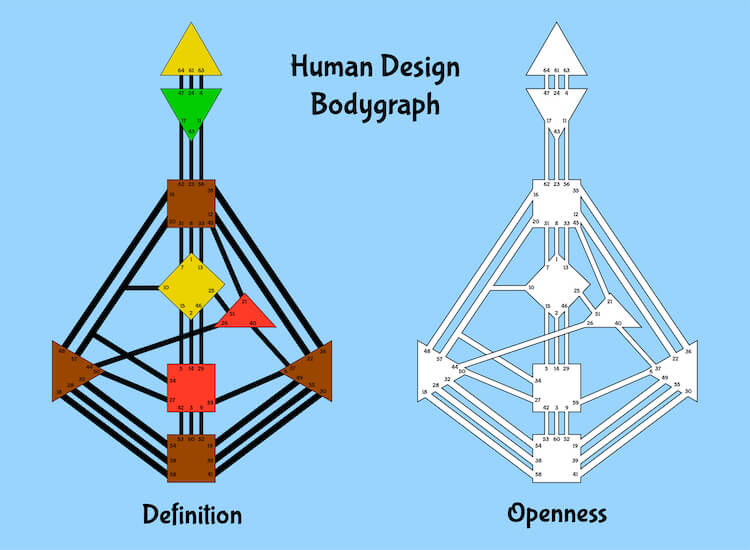
If you look at the energy centers on your own Human Design body chart, you’ll see they appear as either white (open) or coloured (defined) geometric shapes, each representing life force focal points or energy hubs.
Arguably our most important centers, our defined centers contain fixed, consistent access to energy. They are reliable in the different ways they function, and can be considered our strengths.
Open and undefined centers (represented in white) on the other hand are where we are most impressionable and vulnerable, and flexible on our life path.
Our open centers are a great source of wisdom and can be used to learn about the world and contribute to our insight, but we should avoid making decisions from these centers since they may be susceptible to outside influence.
Note that undefined energy centers and open centers are often used as interchangeable terms, but they are technically different. This becomes more apparent when looking at gates and channels, which are the connections between centers and prevent or allow free energy flow between them. (Gates stretch from a center to half way across a channel.)
These, too, can be defined or undefined. In fact, it’s when there is definition between two centers that a center becomes defined. If a white center has no defined gates, then it is completely open. If it does have a defined gate but no defined channel, then the center is classified as undefined.
In this diagram of a Reflector aura type, you can see that some gates are defined, but none of them create a channel between two centers; therefore, three centers are open while most are undefined.

Our open centers are where we are most susceptible to being conditioned (influenced), by the people in our lives, but also by cultural expectations and societal norms.
The Value and Challenges of Open Human Design Centers
An open center can be a source of rich and fascinating input – however it’s generally where you are stuck trying to satisfy those expectations I mentioned earlier. We will never feel at ease trying to be what we are not, and in Human Design, this state is called the not-self mind.
The not-self mind is composed of the monologues on loop in your head, tormenting you, and are driven by your open white centers.
Our open centers are where we are most susceptible to being conditioned (influenced), by the people in our lives, but also by cultural expectations and societal norms.
This can feel confusing because energy input changes based on our environment and who we are around. This can manifest as inconsistent values and beliefs, resulting in questioning our self-worth, because we’re unable to authentically express our true selves.
For each open center within your Human Design body graph, there’s a question to help you determine whether you’re allowing yourself to be influenced, and wisdom which can help you to achieve perspective.
Order Your Human Design Report!
If you’re intrigued by what you’re reading and would like to delve further into your Design, why not order a thorough Human Design reading report for yourself or a loved one?
Hot tip: Use code HD963K2 for a 25% discount when you purchase two or more reports!
Child reports, unique to the market, are now also available to help strengthen your connection with your child, and support their wellbeing.
Unlike the free reports typically available online, the offering from Supernatural Coaching is a 120+ page comprehensive deep-dive into your unique Design and type, also covering profiles and themes and providing a quick reference guide and workbook.

Strategy and Authority in Human Design
In tandem with your body chart (sometimes shown within a mandala overlaid on top of the zodiac signs), Human Design provides two tools, called strategy and authority, to help you harness the energy in your defined and open centers.
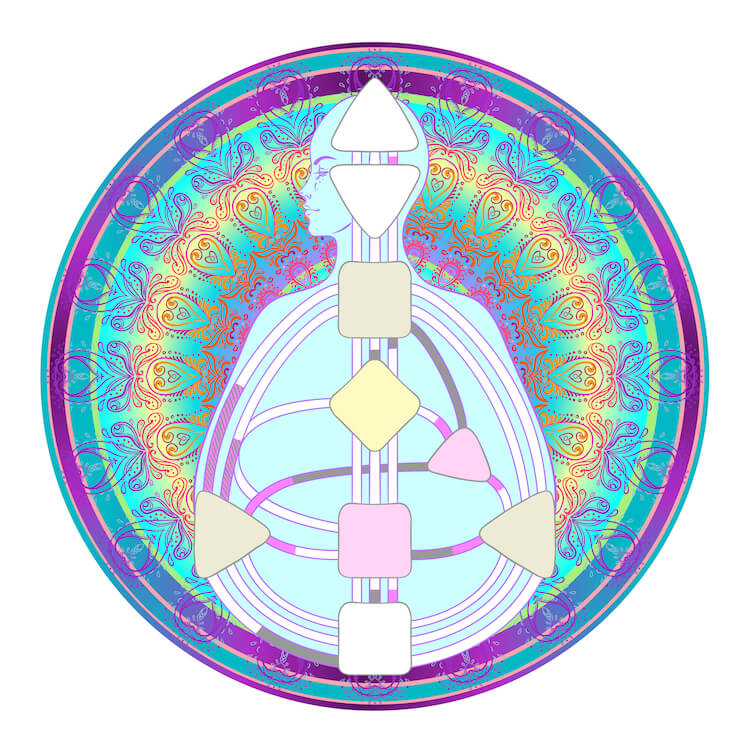
Depending on whether your centers are defined, you may have inner authority or outer authority. Your strategy guides you to use your specific energy efficiently and make correct decisions for your design. You should find yourself naturally in the right place, with right people, doing the right things.
Using the information from your Human Design bodygraph, your unique strategy and authority guides you to work in a specific way with your natural energy, instead of against it. This ultimately allows you to make the decisions which are most in alignment with your true nature and authentic self.
Let’s take a closer look at each of the nine centers.
What Are the Nine Human Design Centers?
As mentioned earlier, Human Design energy hubs are based on the chakra system, which consists of:
- Root
- Sacral
- Solar Plexus
- Heart
- Throat
- Third Eye / Ajna
- Crown center
In HD, we have the following 9 energy centers in our bodies, made up of two pressure centers, four motor centers, three awareness centers, a manifestation center, and an identity center:
- Head center (pressure center)
- Ajna center (awareness center)
- Throat center (manifestation center)
- G center (identity center)
- Heart center (motor center)
- Spleen center (awareness center)
- Solar Plexus center (awareness and motor center)
- Sacral center (motor center)
- Root center (pressure and motor center)
As you can see, there are two additional centers in Human Design. These come from splitting the Heart chakra in two to include the G Center, and splitting the Solar Plexus in two to also include the Splenic center.

Each of our different centers also has its own distinct biological correlation, linked with a specific function of the body (as outlined below).
Following is how each center influences us, dependent upon whether they’re defined or open/undefined.
Head Center (Top Triangle)
Pressure center. Center for inspiration and ideas. Connected to the pineal gland.
The defined Head center:
- Is the mental pressure to think,
- Has energy to think through doubts,
- Has the capacity to be inspirational,
- Can have an interesting perspective.
The undefined Head center:
- Takes on and amplifies the thoughts of others,
- May feel overwhelmed,
- Puts pressure on your shoulders to act on things that don’t concern you or are not your responsibility.
The open Head center question is: Am I trying to answer everybody else’s questions?
Advice: Use your personal strategy to assess what ideas are your own and which are not. Be selective in which you actively engage with, ensuring you pursue only those projects which align with your purpose
Ajna Center or Mind Center (Second Triangle)
Awareness center. Center for conceptualisation and analysis. Linked with the pituitary gland.
The defined Ajna center:
- Is how you think,
- Feels confident in its opinions,
- Has a consistent way of processing and viewing information.
The open Ajna center or undefined Ajna center:
- Feels pressure to commit to a fixed opinion,
- May result in anxiety about inconsistency,
- Can overcompensate by projecting an impression of certainty.
The open Ajna question is: Am I trying to convince everyone/myself that I am sure?
Advice: Keep in mind that it’s not necessary to have a fixed opinion about anything; there is value in remaining openminded and having a fluid perspective.
Throat Center (Top Square)
Center for communication energy and manifestation of ideas into form. Related to the thyroid glands.
The defined Throat center:
- Is about communication;
- Is the center from which all energy in the body is expressed;
- Is where all manifestation, transmutation, and transformation take place;
- Speaks in a fixed way, with consistent expression.
The undefined Throat center:
- Has an inconsistent voice, which can cause anxiety and pressure to speak;
- Can say or express something (manifest) in order to relieve throat energy pressure.
The open Throat center question is: Am I trying to attract attention?
Advice: Seek attention in appropriate ways, and recognise the value in pausing and listening, without feeling a need to fill the silence unless there’s something worth contributing.
G / Self Center or Identity Center (Diamond)
Center for identity, love, and direction in life. Location of the magnetic monopole. Connected to the liver.
The defined G center:
- Is the identity of the self;
- Represents a fixed sense of self;
- Expresses love in a stable, consistent way.
The undefined G center:
- Has an inconsistent identity, which adapts with changing environments;
- Can feel like they need to grasp on to a specific identity to feel secure.
The open G center question is: Am I looking for love and direction?
Advice: Recognise that it’s not necessary to define yourself; it’s okay to be flexible and fluid and not put yourself in a specific box. Choose to spend time with people who make you feel authentic and good and don’t directly or indirectly contribute to your insecurity about your identity.
Heart / Ego Center / Will Center (Small Triangle)
Motor center. Center for ego, willpower, and values. Related to the heart, thymus gland, stomach, and gall bladder.
The defined Heart center:
- Is about willpower and values;
- Makes healthy commitments;
- Can appear stubborn or assertive, especially to those with undefined willpower.
The undefined Heart center:
- Feels pressure to prove and improve itself,
- This can manifest as lack of self-worth.
The open Heart center question is: Do I have something to prove or improve?
Advice: If you have this center undefined, avoid making promises you’re not able to honour – you will end up reneging or burning out from attempting to access willpower you do not possess. Use your strategy to ensure you only make commitments that place your value and the value of others at their heart.

Splenic Center (Left Triangle)
Center for awareness, immune system, time consciousness, and center for intuition. Connected to the lymphatic system.
The defined Splenic center:
- Is about instinct, intuition, and survival;
- Is our most primal awareness;
- Functions in the moment;
- Has a developed sense of intuition.
The open or undefined Spleen center:
- Can feel vulnerable and engage in unhealthy behaviours, in pursuit of security;
- Sensitive, and in tune with physical body;
- An open Spleen may struggle with time-keeping;
- Can act impulsively;
- Might find it hard to know when to let go of things.
The open Splenic center question is: Am I holding on to what is not good for me?
Advice: Trust your own energy and intuition, and learn to let go of things that no longer serve you, including relationships, resentments, clutter, etc. And develop organisational systems to better manage your time!
Emotional Solar Plexus Center (Right Triangle)
Motor and awareness center. Center for emotional energy. Related to the nervous system, the lungs, the kidneys, the bladder, the pancreas, the prostate.
The defined Solar Plexus center (emotional authority):
- Is about mental awareness and emotional intelligence;
- Undulates and cycles between hope and pain, in emotional waves;
- Takes time to and space to consider and evaluate, resisting rash decisions;
- Is often relieved to discover the reason for their fluctuating emotions is simple chemistry.
The undefined Solar Plexus center:
- Absorbs and amplifies the emotional energy of others,
- Learns not to make waves in order to avoid turbulence and conflict.
The open emotional center question is: Am I avoiding confrontation and truth?
Advice: Recognise that the emotional highs and lows you experience may be feelings that you’ve absorbed from others. With this awareness and emotional clarity, feel empowered to shake them off instead of taking them on as your own, and take the time you need to release that negative energy.
Sacral Center (Upper Bottom Square)
Motor center. Powerful center for life force energy. Connected to reproductive organs.
The defined Sacral center:
- Is the source of life force and reproduction,
- Is a response motor and regenerates through fulfilling activity,
- Can become drained and frustrated by unsatisfying tasks.
The undefined Sacral center:
- Has inconsistent access to life force energy;
- Lack of sustainable energy;
- Takes on and amplifies the Sacral energy around them;
- Can indulge in an excess of what is energetically correct for them, leading to addiction.
The open Sacral center question is: Do I know when enough is enough?
Advice: Recognise your limits and avoid taking on more than you can realistically manage, or you risk burnout or addiction.
Root Center (Lower Bottom Triangle)
Pressure and motor center. Center for adrenaline energy and stress. Linked to adrenal glands.
The defined Root center:
- Is about adrenal pressure and stress;
- Moves energy through the body to fuel action;
- Feels consistent compulsion to be active;
- Is a healthy energy if utilised appropriately, in activities such as exercise.
The undefined Root center:
- Is the amplification of adrenal stress, experienced as pressure to be busy;
- Can be persistently exploited by the pressures of daily life.
The open Root center question is: Am I in a hurry to get everything done so I can be free of the pressure?
Advice: Recognise that your open center means that it is normal for you to experience adrenaline energy as pressure. Use this awareness to perceive it in a more productive way, by allowing the energy of that center to wash over you, whilst mindfully releasing excess pressure and consciously relaxing.
Ready to Order Your Report?
Curious to find out more, or order a reading for yourself or a loved one?
A comprehensive report can be an excellent tool to help deepen your relationships. And, newly unique to the market, child reports are now also available to help strengthen your connection with your child, and support their wellbeing.
Hot tip: Use code HD963K2 for a 25% discount when you purchase two or more reports!
Unlike the free reports typically available online, the offering from Supernatural Coaching is a 120+ page comprehensive deep-dive into your unique Design and type, also covering profiles and themes and providing a quick reference guide and workbook.

What Does the Science Say?
There’s currently no evidence to support the philosophy of Human Design or energy centers, which are based on the ancient Hindu principle of chakras.
But – they’re looking1.
Besides which, the questions for each center and the corresponding advice is sound, for everyone – regardless of whether they’re especially vulnerable in these areas.
If the ideas here fascinate you, then there’s certainly no harm in having an open mind and looking more deeply as a spiritual experiment into your personal growth.

Sources
- Wisneski L, Anderson L. The Scientific Basis of Integrative Medicine. Evid Based Complement Alternat Med. 2005 Jun;2(2):257–9. doi: 10.1093/ecam/neh079. Epub 2005 Apr 13. PMCID: PMC1142191.